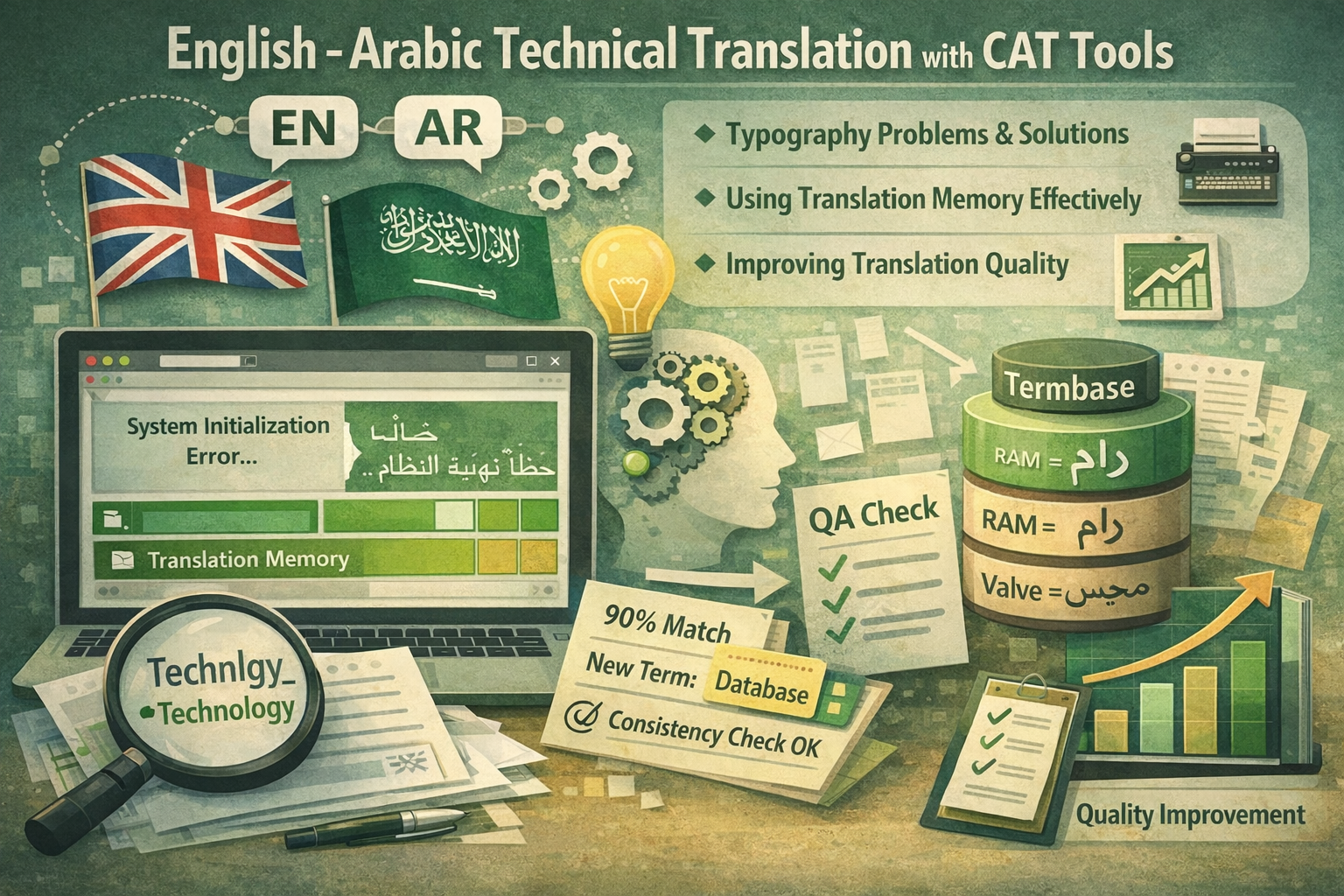
English-Arabic technical translation represents one of the most challenging language pairs in the translation industry. Beyond the obvious linguistic differences between Germanic and Semitic language families, translators must navigate right-to-left (RTL) text direction, complex typography requirements, bidirectional text handling, and significant cultural considerations in technical terminology. Computer-Assisted Translation (CAT) tools have become indispensable for managing these complexities, but only when properly configured and used with a deep understanding of Arabic-specific challenges.
The Fundamental Challenges of English-Arabic Technical Translation
The English-Arabic language pair presents unique obstacles that impact every stage of the translation workflow, from initial analysis to final delivery.
Linguistic and Structural Differences
Arabic's root-based morphological system differs fundamentally from English's structure. Most Arabic words derive from three-consonant roots, with meaning modified through vowel patterns and affixes. This creates particular challenges for technical terminology, where precision is paramount but the language's structure encourages multiple valid expressions of the same concept.
Arabic grammar employs a dual number (in addition to singular and plural), two grammatical genders, and complex agreement rules where adjectives must match nouns in gender, number, case, and definiteness. A single English technical term might require multiple Arabic translations depending on the gender and number of the referenced item, significantly complicating terminology management.
Sentence structure also differs markedly. While English follows Subject-Verb-Object order, Arabic typically uses Verb-Subject-Object, though this can vary for emphasis. Technical writing often requires adapting English's passive constructions, which are heavily used in documentation, into Arabic's preferred active voice while maintaining the same level of formality and precision.
Technical Terminology Complexity
Arabic technical terminology faces ongoing standardization challenges. Modern technical concepts often lack established Arabic equivalents, leading to several competing approaches. Some sectors favor transliteration or arabization (تعريب), adapting foreign terms with Arabic phonetics. Others prefer translation using classical Arabic roots, while still others create new compound constructions.
Regional variations compound this challenge. Egyptian Arabic, Gulf Arabic, and Levantine Arabic may use different technical terms for identical concepts. A "computer" might be "حاسوب" in formal Modern Standard Arabic, "كمبيوتر" (transliterated) in everyday usage, or "حاسب آلي" (literally "automatic calculator") in some technical contexts. Without robust termbase management, consistency becomes impossible in large-scale projects.
Typography and RTL Text Challenges
Arabic typography presents the most visible and technically complex challenges in English-Arabic translation, particularly within CAT tool environments.
Right-to-Left Text Direction
Arabic's RTL text direction affects every aspect of document formatting. Text flows from right to left, document page order reverses, and user interface elements mirror horizontally. CAT tools must properly handle this directionality to maintain readability and prevent display corruption.
The challenge intensifies when documents contain mixed-direction content—Arabic text with embedded English technical terms, product names, or code snippets. These bidirectional (BiDi) text situations require careful Unicode handling to ensure that Latin text within Arabic paragraphs displays in the correct left-to-right direction while maintaining overall RTL flow.
Arabic Script Characteristics
Arabic script is cursive and context-dependent, with letters taking different shapes depending on their position in a word (initial, medial, final, or isolated). This contextual shaping happens automatically in proper Unicode rendering, but CAT tools and file formats that don't fully support complex script rendering can break these connections, producing disjointed, unreadable text.
Additionally, Arabic uses combining diacritical marks (tashkeel) for vowels and pronunciation guidance. While these are typically omitted in technical documentation, certain contexts—particularly instructional materials or documentation for Arabic learners—require them. CAT tools must preserve these marks correctly without treating them as separate segments or filtering them out during quality assurance checks.
Number and Date Formatting
Arabic-language technical documentation uses multiple number systems. While Eastern Arabic numerals (٠-٩) are traditional, Western Arabic numerals (0-9) are increasingly standard in technical contexts, particularly in Gulf countries. Some regions mix both systems, using Western numerals for mathematics and technical data but Eastern numerals for dates and page numbers.
Date formats also vary significantly. Arabic uses a different calendar order (day/month/year), and some contexts require the Hijri (Islamic) calendar alongside or instead of the Gregorian calendar. Technical translators must establish clear conventions for their target audience and configure CAT tool quality assurance to verify consistent application.
Punctuation and Special Characters
Arabic punctuation differs from English in several ways. The Arabic question mark (؟) reverses direction from the English question mark (?), and the Arabic comma (،) differs subtly from the Latin comma (,). Quotation marks follow different conventions, with some style guides preferring guillemets (« ») and others using Latin quotation marks but reversed for RTL text.
Decimal separators present another challenge. While English uses a period (3.14), Arabic often uses a comma (٣٫١٤) or an Arabic decimal separator. Thousands separators may use commas, spaces, or Arabic-specific separators. These variations must be managed consistently across technical documentation.
Solutions for Typography and RTL Management
Successfully managing Arabic typography requires a combination of proper tool configuration, workflow design, and quality assurance processes.
CAT Tool Configuration for RTL
Modern CAT tools like SDL Trados, MemoQ, and memoQ support RTL languages, but require proper configuration. Enable bidirectional text support in your editor settings, configure the interface to display RTL segments correctly, and set up preview modes that accurately render mixed-direction content. Verify that formatting tags don't interfere with text direction changes.
Test your configuration with sample segments containing mixed English-Arabic content, embedded Latin characters within Arabic text, numbers and technical measurements, and formatted text with bold, italics, and other styling. This testing reveals configuration issues before they appear in production work.
File Format Considerations
Not all file formats handle RTL text equally well. HTML and XML files with proper Unicode encoding and direction attributes generally work well. Microsoft Office formats (DOCX, XLSX, PPTX) have good RTL support when properly configured. However, older formats or those generated by legacy systems may require special handling.
When working with InDesign, FrameMaker, or other desktop publishing formats, coordinate closely with the layout team to ensure that text direction properties are preserved through the translation workflow. Missing or corrupted direction markers can cause entire paragraphs to display incorrectly.
Style Guide Development
A comprehensive English-Arabic style guide is essential for consistent typography. Document your preferences for number systems (Eastern vs. Western Arabic numerals), date formats and calendar systems, punctuation styles, quotation mark conventions, and handling of English terms within Arabic text. Include specific guidance for technical elements like measurements, formulas, and code snippets.
How CAT Tools Enhance Arabic Translation Quality
Properly configured CAT tools provide critical quality improvements for English-Arabic technical translation that would be nearly impossible to achieve manually.
Consistency Through Translation Memory
Translation Memory (TM) is particularly valuable for Arabic technical translation due to the language's morphological flexibility. Once you've established the preferred translation for a complex technical concept, TM ensures that exact matches are reused automatically and similar segments are highlighted for consistent adaptation.
For Arabic, TM helps maintain consistency in terminology choices, morphological variations of technical terms, grammatical agreement patterns, and treatment of transliterated terms. This consistency is crucial for technical documentation where readers rely on predictable terminology to understand complex procedures.
Automated Quality Assurance
CAT tools can verify numerous quality aspects specific to Arabic translation. Configure QA checks to identify inconsistent number formats, incorrect text direction in bidirectional content, mismatched punctuation styles, broken contextual letter connections, tag placement errors that disrupt RTL flow, and terminology deviations from your termbase.
These automated checks catch errors that human reviewers might miss, particularly in large documents where maintaining attention to every technical detail becomes challenging. They're especially valuable for verifying that numbers, measurements, and technical specifications remain accurate across translation.
Context and Preview Features
Context awareness is vital for Arabic translation given its grammatical agreement requirements. CAT tools that show surrounding segments help translators choose appropriate gender, number, and case forms for technical terms. Real-time preview features allow verification that translated content appears correctly in RTL layout and that bidirectional text flows naturally.
Maximizing Translation Memory Effectiveness
Translation Memory systems require strategic management to deliver maximum value for English-Arabic technical translation.
Building Domain-Specific TMs
Create separate translation memories for different technical domains. Software localization uses different terminology and style than medical device documentation or engineering specifications. Within each domain, maintain sub-memories for different clients or product lines when terminology preferences vary.
For Arabic, consider whether your TM should differentiate between regional variants. A TM serving Egyptian clients might differ from one for Saudi Arabian audiences, particularly in terminology choices and formality levels. However, maintaining too many separate memories can reduce leverage, so balance specificity with efficiency.
Handling Morphological Variations
Arabic's rich morphology means that useful fuzzy matches may score lower than in other language pairs. A segment might match 85% but require different gender or number agreement throughout, necessitating substantial editing. Train yourself to quickly identify whether a fuzzy match provides actual value or would be faster to translate from scratch.
Consider using TM concordance search features extensively for Arabic. Rather than relying solely on automatic fuzzy matching, search for specific technical terms to find how they've been translated in various grammatical contexts. This approach can be more effective than fuzzy matching for morphologically rich languages.
TM Maintenance and Quality
Regularly audit Arabic TMs for quality and consistency. Review entries for outdated terminology, inconsistent transliteration approaches, and regional variants that may cause confusion. Remove or flag segments with poor translations before they propagate through new projects.
Implement a review workflow where senior translators periodically examine TM content, verify alignment quality in imported memories, and standardize terminology variations. This ongoing maintenance ensures your TM remains a quality asset rather than becoming a repository of historical inconsistencies.
Optimizing Termbase Management for Arabic
A well-structured termbase is the foundation of consistent technical terminology in English-Arabic translation.
Capturing Morphological Information
Arabic termbase entries should include comprehensive grammatical information. Document the gender of nouns (crucial for agreement), common plural forms (which can be irregular in Arabic), and whether terms are derived from Arabic roots or transliterated from foreign languages. Include pronunciation guidance when transliteration standards might vary.
For verbs that appear in technical documentation, note the root pattern and common derived forms. This information helps translators maintain morphological consistency when the same action appears in different grammatical contexts.
Managing Transliteration Approaches
Establish clear policies for transliterating English technical terms that lack established Arabic equivalents. Will you follow official transliteration standards like those from Arabic language academies? Will you adapt terms to match common usage in your target region? Will you maintain English terms unchanged when they're widely recognized?
Document these decisions in your termbase with usage examples. When multiple transliteration variants exist, mark the preferred form clearly and include variants as synonyms so the termbase can recognize them during quality checks.
Regional and Register Variations
If you serve multiple Arabic-speaking regions, your termbase should track regional preferences. Tag terms with their appropriate regional context (Gulf, Levant, North Africa, Egypt) and formality level. Some terms acceptable in informal contexts may be inappropriate for formal technical documentation, and vice versa.
Collaborative Terminology Development
For technical Arabic translation, consider involving native Arabic technical experts in terminology development. Subject matter experts can provide insight into emerging terminology trends, verify that translated terms accurately convey technical concepts, and help navigate situations where Arabic lacks established equivalents for cutting-edge technology.
Working with SDL Trados Project Files for Arabic
SDL Trados remains widely used for technical translation, but its project files require proper handling for Arabic content.
Understanding SDLPPX Packages for RTL Content
Trados project packages (SDLPPX) contain all project resources including source files with language direction metadata, translation memories configured for English-Arabic pairs, termbases with Arabic script support, and quality assurance settings adapted for RTL languages. These packages preserve critical RTL formatting information during project handoffs.
However, when reviewing translated content outside Trados or integrating translations into different systems, you may need to extract content in more universal formats. This is particularly important when working with clients or stakeholders who don't have Trados licenses but need to review Arabic translations.
Converting and Extracting Arabic Content
The linigu.cloud service provides essential conversion capabilities for SDL Trados, MemoQ, and Transit project files, transforming them into standard bilingual XML and TMX (Translation Memory eXchange) formats. For Arabic content, this conversion is particularly valuable because TMX files preserve Unicode text direction properties, enabling them to display correctly in any compliant editor or CAT tool.
Converting Trados packages to bilingual XML allows Arabic content to be reviewed in standard XML editors that support RTL text, integrated into content management systems without Trados dependencies, and shared with reviewers using different CAT tools. The TMX format enables translation memory reuse across different platforms, which is essential for agencies working with multiple tools or clients with varying technology requirements.
Best Practices for File Conversion
When converting Trados project files containing Arabic content, verify several critical aspects. After conversion using services like linigu.cloud, confirm that text direction attributes are preserved correctly and that bidirectional text containing both Arabic and Latin characters displays properly in the target application. Check that Arabic contextual letter shaping remains intact and that all diacritical marks are preserved if present in your source content.
Run quality checks on converted files to ensure number formats remained consistent, punctuation marks weren't corrupted during conversion, and segment alignment between source and target text was maintained accurately. Document your conversion workflow and any special handling required for Arabic content so team members can replicate the process reliably.
Integration and Workflow Optimization
Success in English-Arabic technical translation requires integrating CAT tools into a comprehensive workflow that addresses the language pair's unique challenges.
Pre-Translation Preparation
Before beginning translation, verify that your CAT environment is properly configured for Arabic. Confirm RTL display settings, load appropriate translation memories and termbases, configure QA checks for Arabic-specific issues, and establish clear guidelines for handling bidirectional text. Review the source content for potential issues like hard-coded text direction that might not transfer correctly.
During Translation
Maintain consistent practices throughout translation. Use preview modes frequently to verify RTL rendering, leverage concordance search for morphological variations, apply consistent transliteration rules from your termbase, and flag segments where bidirectional text requires special attention. Regular quality checks during translation catch issues before they compound.
Post-Translation Review
After translation, conduct comprehensive reviews focusing on Arabic-specific quality aspects. Verify overall text direction and layout, check all number and date formatting, confirm punctuation consistency, review technical term translations against the termbase, and test the translated documentation with native Arabic speakers when possible. Use both automated QA tools and human review for comprehensive quality assurance.
Conclusion: Mastering Complex Translation Challenges
English-Arabic technical translation demands exceptional linguistic skill combined with technical proficiency in CAT tools configured for RTL languages. The challenges are substantial—bidirectional text management, complex morphology, evolving technical terminology, and significant typography differences between scripts.
Modern CAT tools, when properly configured and used strategically, transform these challenges into manageable workflows. Translation memories maintain consistency across complex morphological variations. Termbases standardize technical vocabulary and transliteration approaches. Quality assurance features catch RTL-specific errors automatically. File conversion services like linigu.cloud ensure interoperability across different tools and stakeholder requirements.
The key to excellence lies in combining deep Arabic linguistic knowledge with sophisticated tool usage. Invest in building high-quality, domain-specific translation memories and termbases. Develop comprehensive style guides that address Arabic's unique typography requirements. Configure your CAT tools to leverage Arabic's characteristics rather than fighting against them.
By mastering both the linguistic and technical aspects of English-Arabic translation, technical translators can deliver documentation that meets international quality standards while respecting the unique requirements of Arabic script, grammar, and typography. This combination of traditional translation expertise and modern technological capability is essential for success in today's global technical communication environment.

Comments ()
No comments yet. Be the first to comment!