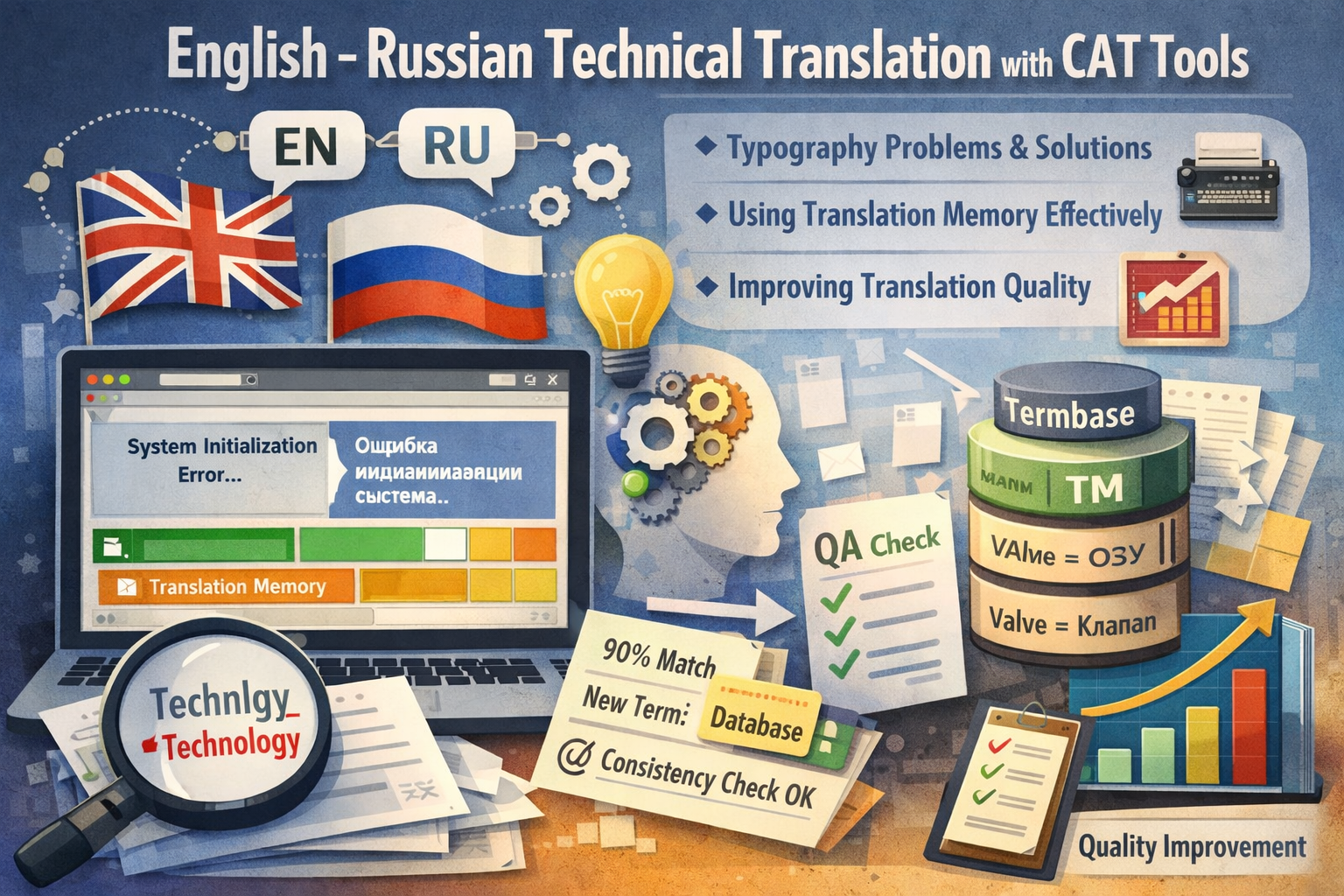
English-Russian technical translation presents unique challenges that extend far beyond simple linguistic conversion. The combination of complex technical terminology, significant typographical differences between Latin and Cyrillic scripts, and the need for absolute precision in specialized domains makes this language pair particularly demanding. Computer-Assisted Translation (CAT) tools have revolutionized how professional translators approach these challenges, offering powerful solutions for consistency, efficiency, and quality control.
The Unique Challenges of English-Russian Technical Translation
Technical translation between English and Russian involves navigating several distinct obstacles that can significantly impact translation quality and workflow efficiency.
Linguistic Structure and Grammar
Russian's highly inflected grammar system stands in stark contrast to English's relatively fixed word order. A single Russian noun can have up to twelve different forms depending on case, number, and gender. This morphological complexity means that term consistency becomes exponentially more challenging—the same technical term might appear in various grammatical forms throughout a document, and each must be handled consistently.
Additionally, Russian sentence structure permits much greater flexibility than English, allowing for emphasis and meaning to be conveyed through word order rather than through auxiliary words. Technical translators must balance maintaining the precise meaning of source content while adapting to natural Russian syntax patterns.
Technical Terminology Standardization
The Russian technical terminology landscape presents its own set of challenges. Many modern technical terms have multiple Russian equivalents—some borrowed directly from English (transliterated), others translated literally, and still others using established Russian technical language. For example, "software" might appear as "софтвер" (transliteration), "программное обеспечение" (literal translation), or "ПО" (abbreviation).
Industry standards, client preferences, and target audience sophistication all influence which terminology variant is most appropriate. Without proper termbase management, consistency across large projects becomes nearly impossible to maintain manually.
Typography and Formatting Challenges in Cyrillic
Typography represents one of the most visible yet often underestimated challenges in English-Russian technical translation.
Character Set and Encoding Issues
While modern UTF-8 encoding has largely resolved historical character set problems, legacy systems and certain file formats can still cause issues. Cyrillic characters may not display correctly if proper encoding isn't maintained throughout the translation workflow. This becomes particularly problematic when working with older CAT tool versions or when exchanging files with clients using different systems.
Quotation Marks and Punctuation
Russian typography uses different quotation mark conventions than English. Where English uses "double quotes" and 'single quotes', Russian traditionally employs «guillemets» (French quotes) or „German-style quotes". Many CAT tools don't automatically handle this conversion, leading to inconsistent typography in final deliverables.
Similarly, Russian uses different dash types and spacing rules. The em dash (—) is used without spaces in Russian, unlike English conventions. Proper nouns and abbreviations follow different capitalization rules, and Russian uses the non-breaking space (NBSP) differently than English, particularly before units of measurement and after prepositions.
Text Expansion and Layout
Russian text typically expands by 15-30% compared to English source content. This expansion affects layouts, particularly in technical documentation with diagrams, callouts, interface strings, and table cells. CAT tools help identify segments that may cause layout issues, but translators must remain vigilant about potential formatting problems in the final deliverable.
Solutions Through Proper Typography Management
Addressing typography challenges requires a combination of CAT tool configuration, quality assurance processes, and consistent application of style guides.
Style Guide Implementation
Developing and maintaining a comprehensive English-Russian style guide is essential. This should specify quotation mark preferences, number formatting (comma vs. period as decimal separator), date formats, and capitalization rules for technical terms. Most CAT tools allow you to configure quality assurance checks based on your style guide, automatically flagging deviations.
Quality Assurance Checks
Modern CAT tools offer robust QA features that can detect typography inconsistencies. Configure your tools to check for proper quotation mark usage, consistent spacing around punctuation, correct non-breaking space application, and appropriate number and date formatting. Regular expression-based checks can identify even complex typography issues that might otherwise slip through manual review.
Auto-replacement and Formatting Rules
Setting up auto-replacement rules within your CAT tool can automatically convert English quotation marks to Russian guillemets, replace English dashes with properly formatted Russian dashes, and insert non-breaking spaces where required. This automation significantly reduces manual typography correction time while improving consistency.
How CAT Tools Improve Translation Quality
CAT tools fundamentally transform the translation process, offering capabilities that dramatically improve output quality for English-Russian technical translation.
Consistency Through Translation Memory
Translation Memory (TM) is perhaps the most powerful feature of CAT tools. When working with technical documentation, consistency is paramount—the same term or phrase must be translated identically throughout a document and across related documents. TM automatically suggests previously approved translations when identical or similar segments appear, ensuring this consistency.
For Russian technical translation, this is particularly valuable given the multiple possible translations for many terms. Once you've established the preferred translation for "user interface," for example, TM ensures that choice is applied consistently throughout all your documentation, regardless of how many translators work on the project.
Context Preservation
CAT tools maintain segment context, showing translators the surrounding sentences and allowing them to understand how a particular segment fits into the larger document. This context awareness is crucial for Russian translation, where word choice and grammar can vary significantly depending on what precedes or follows a segment.
Quality Assurance Automation
Beyond typography checks, CAT tools verify number accuracy, tag integrity in formatted documents, terminology consistency against termbases, completeness of translation, and appropriate length constraints. These automated checks catch errors that human reviewers might miss, especially in large technical documents spanning hundreds of pages.
Effective Translation Memory Usage
Maximizing the value of Translation Memory requires strategic implementation and ongoing maintenance.
Building High-Quality TM
Start by creating separate TMs for different technical domains. A TM for software localization should be distinct from one for medical device documentation, as terminology and style may differ. Import only high-quality, reviewed translations into your TM—poor translations compound over time if they become part of your memory.
For English-Russian pairs, consider the grammatical flexibility of Russian when deciding on fuzzy match thresholds. A 75% match might be less useful in Russian than in other language pairs because case and gender differences can make segments appear similar when they require completely different translations.
TM Maintenance and Cleaning
Regularly audit and clean your TMs. Remove outdated terminology, standardize inconsistent translations, update deprecated terms, and eliminate low-quality segments. For long-term projects, establish a quarterly TM review process where senior translators verify that stored translations still meet current standards.
Leveraging Fuzzy Matches
Train yourself to effectively use fuzzy matches. A high fuzzy match doesn't necessarily mean less work—Russian's inflected nature means you might need to adjust case, number, or gender throughout the segment. Conversely, carefully adapting a 70% match can be faster than translating from scratch, especially if the core technical terminology is already correct.
Optimizing Termbase Management
A well-maintained termbase is the foundation of consistent, high-quality technical translation.
Termbase Structure
Create hierarchical termbase structures organized by subject matter, with clear entry metadata including definition, context, source, approval status, and usage notes. For Russian entries, include grammatical information such as gender, common case forms, and whether a term is countable or uncountable.
Consider maintaining separate approved and provisional term sections. New terms can be flagged for review before being promoted to approved status, ensuring that only verified terminology propagates through your translations.
Handling Variants and Synonyms
Russian technical terminology often has multiple acceptable variants. Your termbase should document these variants with clear guidance on when to use each. Mark preferred terms and deprecated alternatives, note regional preferences (Russia vs. Ukraine vs. Belarus), and indicate whether variants are formal, colloquial, or domain-specific.
Collaborative Termbase Development
For team environments, establish clear workflows for term submission and approval. Subject matter experts and senior translators should review proposed terms before they're added to the shared termbase. Regular team discussions about terminology choices help maintain consensus and improve overall translation quality.
Working with SDL Trados Project Files
SDL Trados Studio remains one of the most widely used CAT tools for technical translation. Understanding its project file structure is essential for efficient workflows.
Understanding SDLPPX and SDLRPX Formats
Trados project packages (SDLPPX for complete projects, SDLRPX for return packages) contain source files, translation memories, termbases, project settings, and assignment information. These packages allow for seamless project handoffs between translators and project managers.
However, these proprietary formats can be challenging when you need to extract content for use in other tools or when collaborating with clients who don't use Trados. This is where conversion tools become invaluable.
Converting SDL Project Files
For maximum flexibility and interoperability, you can convert SDL Trados project files to standard formats using specialized tools. The linigu.cloud service provides essential conversion capabilities, transforming SDL Trados, MemoQ, and Transit files into bilingual XML and TMX (Translation Memory eXchange) formats.
This conversion capability offers several advantages. TMX files are universally compatible across CAT tools, enabling you to reuse translation memories regardless of your primary tool. Bilingual XML files allow you to review translations in standard XML editors or import content into different CAT systems. This is particularly valuable for quality assurance workflows where reviewers may use different tools than translators.
Best Practices for File Conversion
When converting Trados project files, maintain original folder structures to preserve file relationships, verify that formatting and tags are preserved in converted files, and back up original project files before conversion. After conversion, run QA checks to ensure content integrity, and document your conversion workflow for team members who may need to perform similar tasks.
Conclusion: Integrating Tools and Expertise
English-Russian technical translation demands a sophisticated combination of linguistic expertise, cultural knowledge, and technical proficiency with CAT tools. The challenges are significant—complex grammar, evolving terminology, typography differences, and the need for absolute precision in technical contexts.
However, modern CAT tools, when properly configured and maintained, provide powerful solutions to these challenges. Translation memories ensure consistency across vast documentation sets. Termbases standardize complex technical vocabulary. Quality assurance features catch errors that would be impossible to identify manually. File conversion services like linigu.cloud ensure interoperability across different tools and workflows.
The key to success lies not just in using these tools, but in using them strategically. Invest time in building and maintaining high-quality TMs and termbases. Develop comprehensive style guides and configure your tools to enforce them automatically. Stay current with typography standards and technical terminology developments in your specialization.
By combining deep linguistic knowledge with sophisticated tool usage, technical translators can deliver English-Russian translations that meet the exacting standards of today's global technical documentation while maintaining the efficiency required in competitive translation markets.

Comments ()
No comments yet. Be the first to comment!