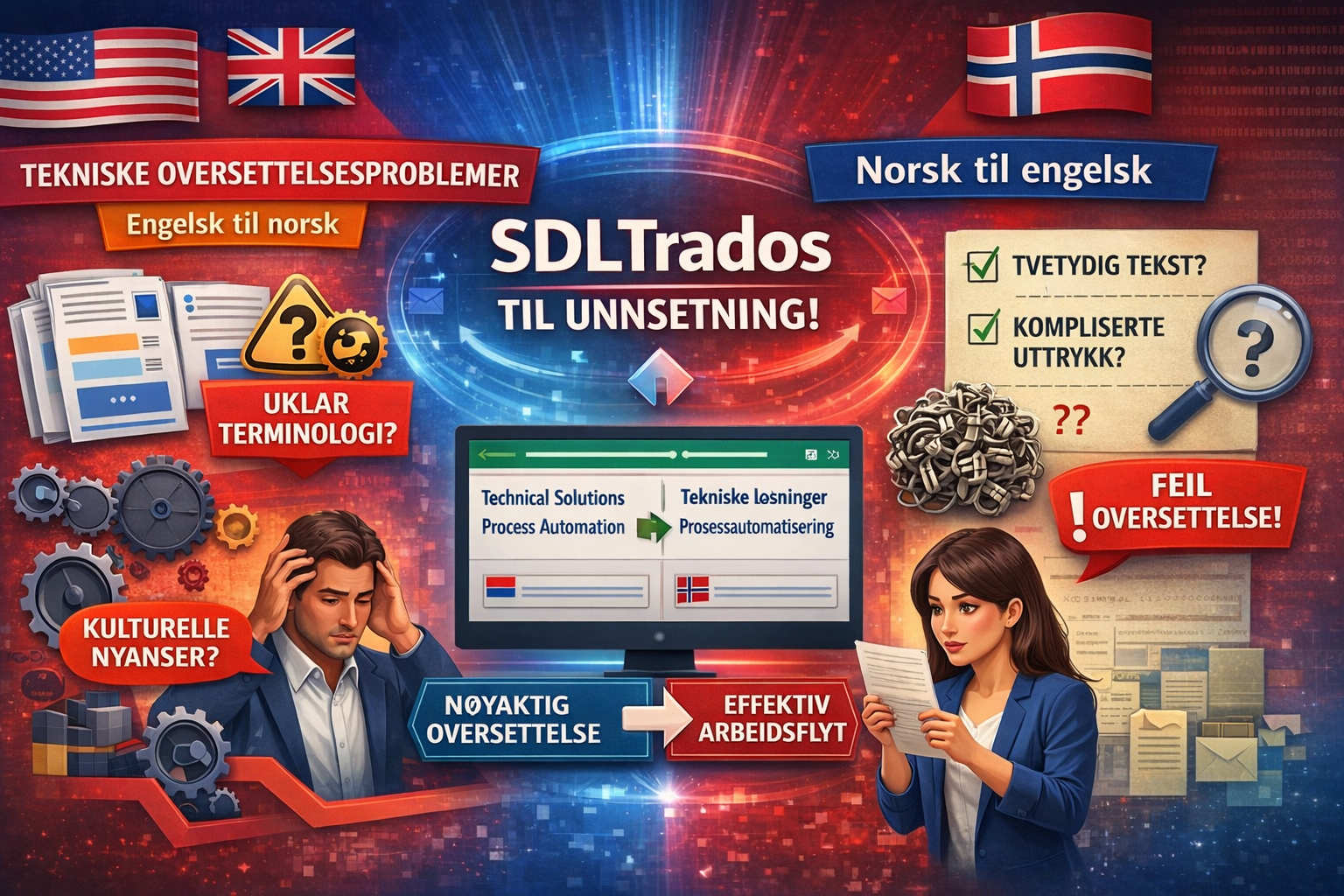
English-Norwegian technical translation presents a unique set of challenges that combine linguistic precision with cultural expectations for clarity and accuracy that are particularly high in Nordic countries. While Norwegian and English share Germanic roots and many structural similarities, the differences in compound word formation, special characters, grammatical gender, and the choice between Bokmål and Nynorsk variants create specific obstacles for technical translators. Computer-Assisted Translation (CAT) tools have become essential for managing these complexities while meeting the exacting quality standards expected in Norwegian technical documentation.
Understanding the English-Norwegian Translation Landscape
Norwegian technical translation operates within a distinctive linguistic and cultural context that shapes every aspect of the translation process.
Bokmål vs. Nynorsk: A Critical Choice
Norwegian exists in two official written forms: Bokmål (literally "book language") and Nynorsk (literally "new Norwegian"). Bokmål, used by approximately 85-90% of the population, evolved from Danish-influenced Norwegian and is the standard for most technical documentation, business communication, and government documents. Nynorsk, based on Norwegian dialects and used primarily in western Norway, represents about 10-15% of written Norwegian.
For technical translators, this means establishing clear guidelines at project inception. Most international companies target Bokmål for broader market reach, but organizations serving specific Norwegian regions or industries may require Nynorsk. Mixing the two variants is unacceptable, and CAT tools must be configured to maintain consistency in vocabulary, spelling conventions, and grammatical structures specific to the chosen variant.
Linguistic Similarities and Deceptive Differences
English and Norwegian share significant vocabulary due to their common Germanic heritage and extensive language contact. However, this similarity creates challenges for technical translation. False friends abound—Norwegian "eventuell" means "possible" rather than "eventual," and "kontrollere" means "to check" rather than "to control." These subtle differences can lead to serious misunderstandings in technical contexts where precision is paramount.
Norwegian grammar also diverges from English in critical ways. Norwegian maintains grammatical gender (masculine, feminine, and neuter) for nouns, affecting article usage and adjective agreement. The language uses V2 word order (verb in second position), different from English's strict SVO pattern. Norwegian's use of reflexive pronouns and passive constructions follows distinct patterns that technical translators must master to produce natural-sounding documentation.
Compound Word Formation
Norwegian, like other Germanic languages, freely creates compound words by joining multiple words without spaces. Where English might write "user interface design guidelines," Norwegian produces "brukergrensesnittdesignretningslinjer" as a single word. This compounding capability creates both opportunities and challenges for technical translation.
Technical documents in Norwegian often contain extremely long compound words that precisely capture complex concepts. While this precision is valuable, it also complicates translation memory matching, termbase management, and text expansion calculations. A single English term might correspond to multiple Norwegian compounds depending on context, or a long Norwegian compound might need to be broken into a multi-word phrase when retranslating to English.
Typography and Special Character Challenges
Norwegian typography presents specific challenges related to special characters, punctuation conventions, and formatting standards.
Norwegian Special Characters
Norwegian uses three special characters beyond the standard Latin alphabet: æ (Æ), ø (Ø), and å (Å). These characters are essential letters in the Norwegian alphabet, not accented variants, and appear in common words including technical terminology. The letter å replaced aa in 1917, though some proper nouns and older texts still use the aa spelling.
These special characters must be handled correctly throughout the translation workflow. Character encoding issues can corrupt these letters, particularly when files pass through systems or tools that don't properly support Unicode. CAT tools must be configured to recognize æ, ø, and å as distinct letters for spell-checking, sorting, and quality assurance purposes.
Alphabetical Ordering
Norwegian alphabetical order places æ, ø, and å at the end of the alphabet, after z. This affects glossaries, indexes, and any alphabetically sorted content. Technical documentation often includes alphabetical lists of terms, functions, or components, and maintaining proper Norwegian alphabetical order is essential for usability.
CAT tools and termbase systems must be configured to sort according to Norwegian conventions. Default ASCII or English alphabetical sorting will misplace entries containing these characters, creating confusion and potentially making technical references difficult to locate.
Number and Date Formatting
Norwegian number formatting uses specific conventions that differ from English. Norwegian uses a space (or sometimes a period) as a thousands separator and a comma as a decimal separator—exactly opposite to English conventions. The number "1,234.56" in English becomes "1 234,56" in Norwegian.
Date formatting also follows different patterns. Norwegian typically uses DD.MM.YYYY format (e.g., 31.12.2024) where English might use MM/DD/YYYY or DD/MM/YYYY depending on regional variant. Time is expressed in 24-hour format, and Norwegian uses different prepositions and grammatical constructions when expressing dates in prose.
Quotation Marks and Punctuation
Norwegian quotation mark conventions have evolved, with traditional guillemets (« ») giving way to English-style quotation marks ("") in most modern usage, though style guides vary. Technical documentation should establish clear conventions and apply them consistently.
Norwegian uses different conventions for apostrophes, particularly in genitive constructions. Where English adds 's to show possession, Norwegian often uses the same pattern but with different spacing and application rules. Norwegian also employs different dash types and spacing conventions compared to English.
Solutions for Typography and Special Character Management
Successfully managing Norwegian typography requires proactive configuration and consistent quality assurance processes.
Character Encoding Best Practices
Always work with UTF-8 encoding throughout your translation workflow. Verify that your CAT tool's default encoding is UTF-8, confirm encoding settings when importing and exporting files, and test file transfers between systems to ensure special characters remain intact. Document your encoding standards and share them with clients and project managers to prevent corruption during file handoffs.
Quality Assurance Configuration
Configure your CAT tool's QA features to verify Norwegian-specific requirements. Set up checks for correct number formatting (space/comma conventions), proper date format usage, consistent quotation mark styles, correct alphabetical ordering in lists, and appropriate handling of compound words. These automated checks catch errors that might escape manual review, particularly in long technical documents.
Style Guide Development
Create a comprehensive English-Norwegian style guide that addresses typography conventions, number and date formatting rules, quotation mark preferences, compound word formation guidelines, and treatment of English terms in Norwegian text. Reference authoritative sources like the Norwegian Language Council (Språkrådet) for standardized terminology and style recommendations.
How CAT Tools Enhance Norwegian Translation Quality
Computer-Assisted Translation tools provide critical capabilities that significantly improve the quality and efficiency of English-Norwegian technical translation.
Consistency Management
Norwegian technical documentation demands exceptional consistency, particularly given the precision-oriented culture of Nordic countries. CAT tools ensure that technical terms are translated identically throughout documentation sets, compound word formation follows established patterns, special characters appear correctly in all instances, and grammatical choices remain consistent across related documents.
This consistency is particularly valuable when multiple translators work on large documentation projects. Translation memory ensures that all team members access approved translations, maintaining a unified voice and terminology even across hundreds of pages of technical content.
Handling Compound Word Variations
CAT tools with robust fuzzy matching capabilities can identify similar segments even when Norwegian compound word formation varies. Advanced tools can recognize that "brukergrensesnitt" (user interface) and "brukergrensesnittdesign" (user interface design) share a common root, suggesting relevant translation memory matches that might otherwise be missed.
However, translators must understand fuzzy matching limitations with Norwegian compounds. Two segments with identical English source text might require different Norwegian translations depending on how compound words should be constructed in each context. Relying too heavily on automatic suggestions without contextual review can produce awkward or incorrect Norwegian phrasing.
Quality Assurance Automation
Automated QA features are particularly valuable for Norwegian translation, catching issues like incorrect special characters (e.g., ä instead of æ), improper number formatting, English quotation mark usage where Norwegian conventions should apply, compound words inappropriately split with spaces, and inconsistent terminology across segments. These automated checks maintain quality standards that would be nearly impossible to verify manually across large technical documentation sets.
Optimizing Translation Memory for Norwegian
Translation Memory effectiveness depends on strategic development and maintenance practices tailored to Norwegian language characteristics.
Building Domain-Specific Memories
Create separate translation memories for different technical domains and industries. Software localization requires different vocabulary and style than medical equipment documentation or engineering specifications. Within each domain, consider maintaining variant-specific memories when you work with both Bokmål and Nynorsk to prevent cross-contamination of terminology and grammar patterns.
Populate your TMs with high-quality, reviewed translations from the start. Poor translations that enter your memory during initial projects will propagate through future work, compounding quality issues over time. Implement a review process where senior translators verify segments before they're committed to shared translation memories.
Managing Compound Word Challenges
Norwegian compound words create unique challenges for translation memory leverage. A segment might contain the same English technical term but require different Norwegian compounds depending on context. Train yourself to recognize when fuzzy matches truly accelerate work versus when they provide false confidence.
Consider using concordance search features extensively for Norwegian translation. Rather than relying solely on automatic segment matching, search your TM for specific English technical terms to see how they've been translated in various contexts. This approach often provides better insights into appropriate compound word formation than automatic fuzzy matching.
Text Expansion Considerations
Norwegian text typically expands 10-20% compared to English source content, though the extensive use of compound words can sometimes reduce this expansion. This affects user interface strings, table cell content, diagram labels, and formatted documents. Configure your CAT tool to flag segments that exceed length limits and monitor expansion rates throughout projects to identify potential layout issues early.
TM Maintenance and Quality Control
Regularly audit your Norwegian translation memories for quality and consistency. Review entries for outdated terminology, inconsistent compound word formation, variant mixing (Bokmål/Nynorsk), special character errors, and changes in Norwegian language standards. The Norwegian Language Council periodically updates terminology recommendations, and your TM should reflect current standards.
Effective Termbase Management for Norwegian
A well-maintained termbase is fundamental to producing consistent, high-quality Norwegian technical translation.
Structuring Norwegian Termbase Entries
Norwegian termbase entries should include comprehensive grammatical and usage information. Document the grammatical gender of nouns (critical for article usage and agreement), approved compound word formations, plural forms (which can be irregular), and whether terms are Bokmål-specific, Nynorsk-specific, or shared. Include usage context and example sentences to guide translators in applying terms correctly.
For technical terms borrowed from English, note whether the term should be kept in English, transliterated, or translated. Some technical domains favor English terms (particularly in IT), while others strongly prefer Norwegian equivalents. Your termbase should reflect these domain-specific preferences.
Handling Norwegian Language Variants
If you work with both Bokmål and Nynorsk, structure your termbase to clearly distinguish between variants. Some terms are identical in both variants, while others differ significantly. Tag entries appropriately and configure your CAT tool to display only the relevant variant during translation to prevent contamination.
Include standardized terminology from authoritative Norwegian sources like the Norwegian Language Council, industry-specific terminology standards, and client-specific preferences when they differ from general standards. Reference these sources in your termbase entries to provide translators with authoritative justification for terminology choices.
Compound Word Guidelines
Establish clear guidelines for compound word formation in your termbase. Document when technical terms should be written as compounds versus separate words, how to handle compound words that become extremely long (some style guides recommend hyphenation or spacing for readability), and conventions for combining Norwegian and English elements in technical compounds.
Include common compound word components as separate termbase entries with usage notes. Understanding that "bruker-" means "user" as a prefix and "grensesnitt" means "interface" helps translators construct appropriate compounds in new contexts.
Collaboration and Review Processes
For team environments, establish workflows for termbase development that include subject matter expert review, particularly native Norwegian technical experts who can verify that terms accurately convey technical concepts and sound natural to Norwegian speakers. Regular team terminology discussions help maintain consensus and improve overall translation quality.
Working with SDL Trados Project Files for Norwegian
SDL Trados Studio remains one of the most widely used CAT tools for technical translation, and understanding its project file handling is essential for efficient Norwegian translation workflows.
Configuring Trados for Norwegian
Proper Trados configuration for Norwegian translation includes setting Norwegian (Bokmål) or Norwegian (Nynorsk) as target language with appropriate regional settings, configuring spell-checking to recognize Norwegian special characters, establishing quality assurance rules for Norwegian number and date formats, and setting up verification for Norwegian quotation mark conventions and special character usage.
Test your configuration with sample Norwegian content containing all special characters (æ, ø, å), compound words of varying length, numbers with Norwegian formatting, and mixed Norwegian-English technical terminology. This testing reveals configuration issues before production work begins.
Understanding SDLPPX Project Packages
Trados project packages (SDLPPX for complete projects, SDLRPX for return packages) bundle all project resources including source files with proper language settings, translation memories configured for English-Norwegian, termbases with Norwegian terminology, and project-specific quality assurance rules. These packages streamline project handoffs between translators and project managers while maintaining configuration consistency.
However, these proprietary formats can limit flexibility when you need to extract content for use in other tools, when collaborating with stakeholders using different CAT systems, or when archiving project data in universal formats. This is where file conversion becomes valuable.
Converting Trados Files for Interoperability
The linigu.cloud service provides essential conversion capabilities for SDL Trados, MemoQ, and Transit project files, transforming them into standard bilingual XML and TMX (Translation Memory eXchange) formats. For Norwegian projects, this conversion offers several advantages.
TMX files enable translation memory reuse across different CAT platforms, which is particularly valuable when working with clients who use various tools or when transitioning between CAT systems. Bilingual XML files allow Norwegian translations to be reviewed in standard XML editors, integrated into content management systems without CAT tool dependencies, and shared with reviewers who may not have access to SDL Trados.
This interoperability is increasingly important in collaborative translation environments where different stakeholders use different tools but need access to Norwegian translation content.
Best Practices for File Conversion
When converting Trados project files containing Norwegian content using services like linigu.cloud, verify several critical aspects to ensure conversion quality. After conversion, confirm that Norwegian special characters (æ, ø, å) display correctly in both uppercase and lowercase, number formatting conventions are preserved, compound words remain intact without unwanted spaces, and segment alignment between English source and Norwegian target is accurate.
Run quality checks on converted files to verify tag preservation, terminology consistency, and completeness. Document your conversion workflow including pre-conversion preparation steps, verification procedures, and any special handling required for Norwegian content. This documentation ensures consistent results when team members need to perform conversions.
Workflow Integration and Best Practices
Excellence in English-Norwegian technical translation requires integrating CAT tools into a comprehensive workflow that addresses the language pair's specific characteristics.
Pre-Translation Planning
Before beginning translation, clarify whether the target is Bokmål or Nynorsk, verify that your CAT environment is configured for Norwegian special characters, load appropriate translation memories and termbases, review source content for potential compound word formation challenges, and identify any Norwegian language standards or style guides that should be followed.
Communicate with clients about their expectations regarding terminology preferences, formality level, industry-specific conventions, and any existing Norwegian terminology they've established in previous documentation.
During Translation
Maintain consistent practices throughout the translation process. Apply compound word formation consistently according to your style guide, use concordance search to verify terminology in various contexts, leverage preview modes to check text expansion and formatting, flag segments where Norwegian phrasing differs significantly from English structure, and maintain a running list of new terms for termbase addition.
Quality Assurance and Review
After translation, conduct comprehensive quality assurance that includes automated checks for Norwegian-specific issues, manual review by native Norwegian speakers when possible, verification of technical accuracy with subject matter experts, and testing documentation with actual Norwegian users when feasible. The high quality expectations in Nordic markets demand thorough review processes.
Conclusion: Precision Through Tools and Expertise
English-Norwegian technical translation requires balancing linguistic precision with cultural expectations for clarity and accuracy that are particularly demanding in Nordic contexts. The challenges include managing Bokmål versus Nynorsk variants, handling Norwegian special characters and typography conventions, constructing appropriate compound words, and maintaining consistency across large documentation sets.
Modern CAT tools, when properly configured for Norwegian language characteristics, provide essential capabilities for meeting these challenges. Translation memories ensure terminology consistency across complex technical documentation. Termbases standardize compound word formation and special character usage. Quality assurance features automatically verify Norwegian formatting conventions. File conversion services like linigu.cloud enable seamless interoperability across different CAT platforms and stakeholder requirements.
Success requires combining deep knowledge of Norwegian language and culture with sophisticated CAT tool usage. Invest in building high-quality translation memories specific to your technical domains. Develop comprehensive termbases that capture Norwegian grammatical nuances and compound word patterns. Configure quality assurance to verify Norwegian typography and formatting standards automatically.
By mastering both the linguistic subtleties of Norwegian and the technical capabilities of modern CAT tools, technical translators can deliver documentation that meets the exacting standards expected in Norwegian markets while maintaining the efficiency required in competitive translation environments. This integration of traditional translation expertise with advanced technology is essential for excellence in English-Norwegian technical translation.

Comments ()
No comments yet. Be the first to comment!